Revolutionizing Warehouse Operations with AtomIQ
Leading Warehouse Distributor Transforms Operations and Achieves Complete Visibility &…

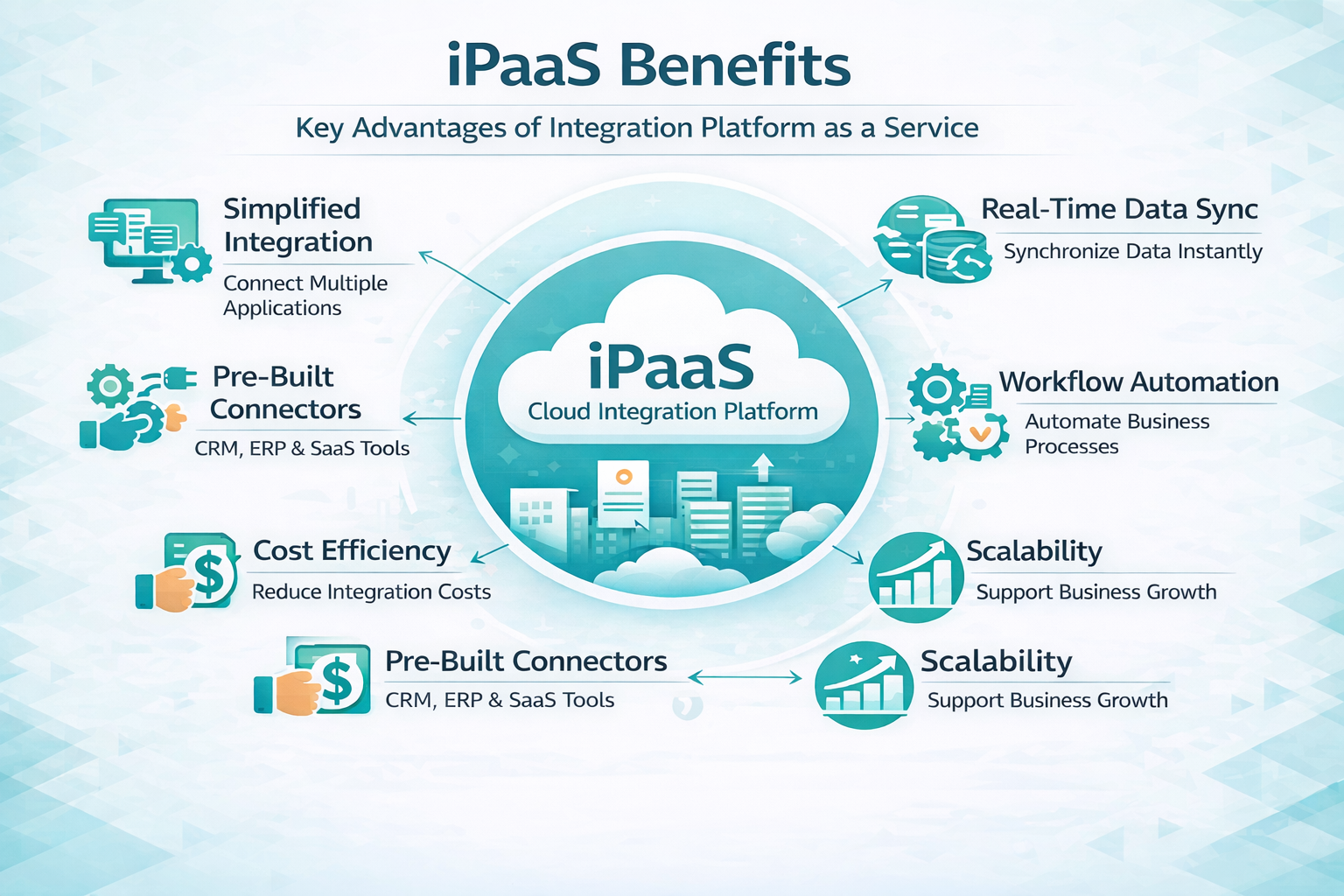
10 iPaaS Benefits: How Integration Platform as a Service Improves Business Integration (2026)
iPaaS (Integration Platform as a Service) is a cloud integration platform that enables businesses to connect applications, data, and systems across cloud and on-premise environments. It acts as an API integration platform that simplifies data exchange, automates workflows, and improves operational efficiency.
This guide explains the key iPaaS benefits and how integration platform as a service helps businesses streamline operations and improve connectivity.
This is where an iPaaS platform (Integration Platform as a Service) becomes essential. An iPaaS platform is a cloud integration platform that connects applications, APIs, and data across different systems. By enabling seamless business system integration, iPaaS platforms allow organizations to automate workflows, synchronize data in real time, and improve operational efficiency.
As businesses increasingly adopt SaaS applications and cloud technologies, the need for scalable integration solutions continues to grow. Integration platform as a service solutions simplify connectivity between systems, eliminate manual data transfer, and help organizations manage complex technology ecosystems.
Understanding the key iPaaS benefits helps organizations build flexible integration architectures that support digital transformation and long-term growth. This guide explores how iPaaS platforms work, their advantages, and real-world use cases across industries.
Integration Platform as a Service (iPaaS) is a cloud-based integration platform that enables organizations to connect applications, APIs, data sources, and business processes across different environments.
Instead of building custom integrations from scratch, companies can use an iPaaS platform to design, deploy, and manage integrations from a centralized cloud environment.
An iPaaS platform connects:
Key characteristics that enable Modern iPaaS platforms provide several important capabilities:
Before exploring the advantages in detail, it is important to understand what iPaaS benefits mean for businesses.
iPaaS benefits refer to the operational, technical, and strategic advantages organizations gain by using a cloud-based integration platform to connect systems and automate workflows.
Unlike traditional integration methods that rely on complex middleware infrastructure and custom coding, iPaaS platforms provide:
Organizations adopt iPaaS platforms to simplify integration challenges, automate business processes, and improve data connectivity across systems.
Below are the 10 key iPaaS benefits that help businesses improve efficiency and scalability.
According to industry reports, the global iPaaS market is expected to grow significantly as businesses adopt cloud integration platforms to streamline operations.
Studies show that organizations using iPaaS tools can reduce integration time by up to 60%.
Organizations typically use multiple platforms such as:
Accurate data is essential for making informed business decisions.
iPaaS platforms enable real-time data synchronization, ensuring information is always updated across systems.
For example, when customer data changes in a CRM system, it can automatically update in:
Traditional integration approaches often require significant infrastructure investment and custom development.
iPaaS platforms reduce operational costs by eliminating the need for:
As organizations grow, they adopt more applications and generate larger volumes of data.
iPaaS platforms provide scalable infrastructure capable of supporting:
Modern software systems rely heavily on APIs for communication.
iPaaS platforms provide API management capabilities, enabling organizations to:
Digital transformation initiatives require organizations to integrate many systems quickly.
iPaaS platforms support digital transformation by:
Managing data across multiple systems can create governance challenges.
iPaaS platforms improve data governance by providing:
Many organizations operate in hybrid environments that combine cloud applications and on-premise systems.
iPaaS platforms support hybrid integration by connecting:
Managing multiple integrations separately can become complex.
iPaaS platforms provide centralized dashboards where organizations can:
Organizations previously relied on middleware or custom integrations. However, iPaaS platforms offer several advantages.
Feature | iPaaS | Traditional Middleware |
Deployment | Cloud-based | On-premise infrastructure |
Scalability | Highly scalable | Limited scalability |
Implementation | Faster deployment | Longer development cycles |
Maintenance | Managed by provider | Requires internal IT teams |
Cost | Lower operational cost | Higher infrastructure costs |
Because of these advantages, many companies are replacing traditional integration methods with modern cloud integration platforms.
iPaaS platforms support integration needs across multiple industries and business functions.
E-commerce Integration
E-commerce businesses integrate systems such as:
Many organizations integrate ERP and CRM platforms to synchronize financial and customer data.
Common integration scenarios include:
Marketing teams often use multiple tools such as email marketing platforms, CRM systems, and analytics solutions.
iPaaS platforms connect these tools to enable:
Supply chain operations require accurate data exchange between warehouse systems, procurement platforms, and logistics providers.
iPaaS platforms ensure real-time data synchronization across these systems, improving inventory visibility and logistics planning.
Several technology vendors provide integration platform as a service solution used by enterprises worldwide.
Some popular iPaaS platforms include:
These platforms offer tools for application integration, API management, and workflow automation.
Organizations evaluate iPaaS platforms based on scalability, connector availability, ease of use, and pricing.
Several technology vendors provide integration platform as Modern organizations require flexible integration solutions to manage growing application ecosystems.
AtomiQ’s iPaaS integration platform helps businesses:
One of the most important reasons companies adopt integration platforms is to simplify system connectivity. Understanding how iPaaS benefits improve system integration helps businesses design better technology ecosystems.
iPaaS platforms improve integration through several mechanisms.
Many integration platforms provide pre-built connectors for commonly used applications.
Examples include:
iPaaS platforms provide centralized dashboards where businesses can manage all integrations in one place.
Benefits include:
Managing integrations across multiple applications can be complex.
Request a Free Demo of AtomiQ’s iPaaS Integration Platform to see how your organization can:
Integration Platform as a Service (iPaaS) has become essential for modern businesses looking to connect applications, automate workflows, and improve operational efficiency. By leveraging cloud-based integration, organizations can eliminate data silos and enhance real-time decision-making.
Understanding the key iPaaS benefits allows businesses to scale faster, improve agility, and reduce IT complexity. As digital transformation accelerates, adopting iPaaS solutions is critical for maintaining competitive advantage.
By adopting iPaaS Integration, businesses can build flexible integration architectures that support long-term growth and digital transformation initiatives. As companies continue to adopt cloud technologies, integration platforms will play an increasingly important role in enabling seamless connectivity across business applications.
Middleware is typically installed and managed within an organization’s infrastructure, while iPaaS is a cloud-based integration platform that provides scalable integration capabilities without requiring on-premises deployment.
Common iPaaS use cases include:
Yes. Many modern iPaaS platforms offer scalable pricing and low-code tools, making them suitable for both small businesses and large enterprises.
iPaaS platforms support digital transformation by enabling organizations to integrate cloud applications with legacy systems, automate workflows, and create unified data ecosystems.
Get a Free Personalized Demo of our WMS Software
See AtomiQ can optimize your warehouse operations and reduce costs.
"*" indicates required fields
Upcoming Webinars
A Guide to a Seamless WMS Implementation
A Guide to a Seamless WMS Implementation
Get Started with Advanced Warehouse Management

Leading Warehouse Distributor Transforms Operations and Achieves Complete Visibility &…

Leading Apparel Manufacturer Digitizes Warehouse Operations with Powerful Integration of…

Global Multi-Facility Manufacturer Launches Cycle Count Apps to Streamline Inventory…

Leading Global Manufacturer Empowers Field Users for Efficient Order Management…

Global Automotive Manufacturer Launches PO Approval Apps for 200+ Users

Leading Commercial Beverage Systems Manufacturer Digitizes Shopfloor Management to Overcome…

Leading Industrial Equipment Manufacturer Enhances Work Order Scheduling in E1

Learn how leading companies are automating and simplifying expense management…

Leading global manufacturer of home building products rolls out warehouse…

Leading global manufacturer integrates with their third-party freight provider to charges in real-time.